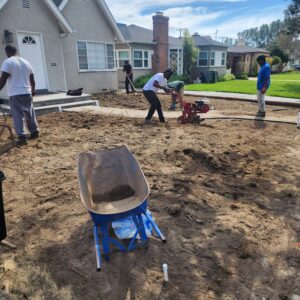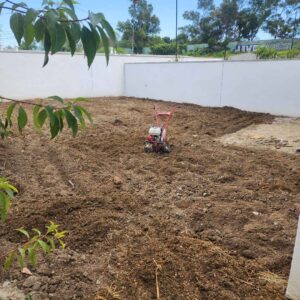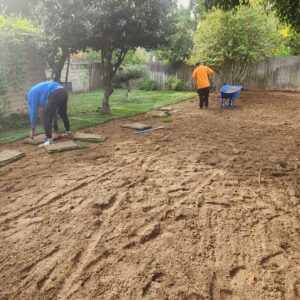

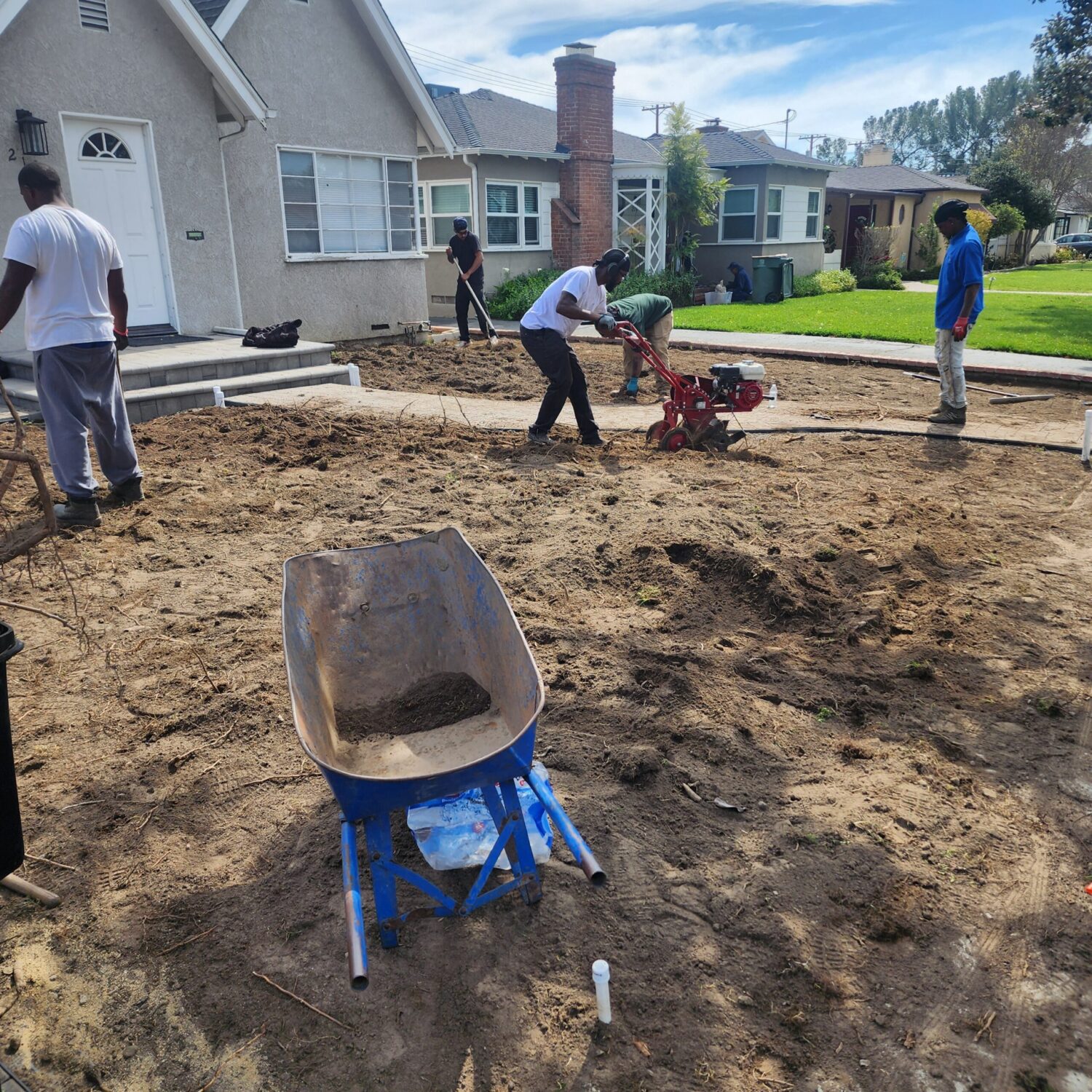
Two hours into a front yard job in Los Angeles County. The old lawn was already stripped, the roots were raked into piles, and one of our crew was walking the tiller across what was left. From the sidewalk it looked like a wreck. To us it was the part of the job that decides whether the new lawn is still green in August or dead by the Fourth of July.
Homeowners call us and ask about sod. What they are actually paying for is everything that happens under it. Rototilling before sod is not an extra line item we tacked on to pad an estimate. It is the difference between grass that roots down and grass that sits on top of hard dirt like a rug.
What that front yard looked like before we touched it
An old lawn, probably thirty or forty years in the same spot. Thin in the sun, bare under the tree, and hard enough in September that you could not push a screwdriver into it. Pavers and a front walkway that the homeowner wanted to keep. An irrigation system that mostly worked, with heads scattered through the yard — you can see two of the risers capped in white PVC in the photo, sticking up so nobody drives a tiller into them.
That is about as typical a Southern California front yard as it gets. Nothing unusual about it and it is exactly the kind of yard where people try to save money by dropping sod straight over the top.
Why you cannot just lay sod over an old lawn
Sod is not a carpet. It is live grass with about an inch of soil and root mat attached, and it only survives if those roots reach real soil within the first two weeks. Roll it over a dead lawn and what you have created is a layer of thatch between the new roots and the ground. Water hits it and runs sideways. The sod dries out from underneath, the seams pull apart, and around week three the whole thing starts going tan in patches. We get called out to fix that job more often than we get called to do the original one.
Old grass does not die quietly especially Bermuda and kikuyu
This is the Los Angeles problem specifically. Bermuda and kikuyu grass do not spread by seed alone; they run underground rhizomes and surface stolons, and a four-inch piece of rhizome left in the soil is a whole new plant waiting for warm weather.
Here is the honest part, and it is worth saying because a lot of companies will not: a rototiller by itself does not kill Bermuda grass. Chopping it up can actually spread it. Instead of one root system you now have forty starts scattered through freshly loosened soil. When we find heavy Bermuda or kikuyu, we tell the homeowner up front that the yard needs a kill period — removal plus solarization, or a treatment window before the sod goes down. It pushes the project out a couple of weeks. It also means the lawn is still clean two summers later.
Compacted soil is the other half of the problem
Most of the LA basin sits on clay-heavy soil, and a front yard that has been walked on, mowed, and irrigated for decades gets pressed into something closer to a driveway base than a growing medium. Roots cannot push through it. Water does not soak in, it sheets off toward the sidewalk.
Tilling breaks that compacted layer open and mixes air back into the top six to eight inches. That is the whole point of the machine. Everything else the raking, the grading, the amendment is built on top of that one thing.
How deep should you rototill before laying sod?
For new sod, six to eight inches is the working number. Sod roots put most of their growth into the top four to six inches during the first season, so you want loosened, amended soil a little deeper than the roots will reach.
For planting beds, vegetable gardens, or anywhere you are putting in shrubs, we go deeper usually ten to twelve inches, sometimes with a second cross pass at a right angle to the first. And on the flip side, if there is shallow irrigation or roots from a mature tree, sometimes we go shallower on purpose and amend more aggressively instead. There is no single depth that is right for every yard, which is part of why the rental yard machine is not always the answer.
Sprinkler lines are the real reason this is not a weekend rental job
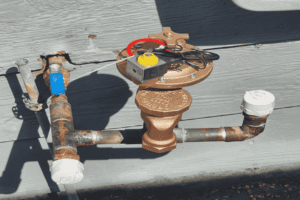
Look at the photo again. Those capped white risers are not decoration. Before the tiller comes off the trailer, we walk the yard, find every head, mark them, and cap what needs capping.
A rototiller running at six inches will find a poly lateral buried at four inches every single time. So will low-voltage lighting wire. Older Los Angeles homes sometimes have galvanized irrigation lines that were installed decades ago and never mapped, and when one of those gets caught, you are not patching a line — you are digging a trench across a yard you were about to sod.
For anything deeper than routine tilling, or in a yard where nobody knows what is buried, call 811 (Underground Service Alert of Southern California) before the work starts. It is free and it is required in California. We do this as part of our process, but if you are doing the work yourself, do not skip it.
What happens to everything that comes out
Old sod chunks, roots, rock, and the surprise layer of gravel somebody left in 1987 — none of that gets tilled back in and buried. It gets wheelbarrowed out, loaded, and hauled off as green waste. That blue wheelbarrow in the photo made a lot of trips that morning.
Burying old sod under new sod is a shortcut that shows up later as soft spots and settling. Once organic material breaks down under a new lawn, the surface drops, and you end up with dips you cannot mow evenly.
Amending and grading before the sod goes down
After the first pass, we bring in compost or a sandy loam blend — usually an inch or two spread across the surface — and make a second pass to work it in. Then it gets raked to grade, sloped away from the house and toward the drainage, and rolled lightly so the surface is firm enough to lay on without being compacted again.
Grading matters more than most people expect. A front yard that slopes the wrong way sends water toward a foundation or pools against a walkway, and no amount of good sod fixes that.
Should you rent a rototiller and do it yourself?
Sometimes, honestly, yes. A small vegetable bed in soil that has been worked before. With no irrigation running through it, is a reasonable weekend rental job.
Where it goes wrong:
- Dry clay. A front-tine rental tiller will bounce across hard Los Angeles clay and barely scratch it. If you are doing it yourself, soak the area deeply two days beforehand — damp, not muddy.
- Unknown irrigation. Covered above. This is the expensive mistake.
- Slopes and tight side yards. Machines get away from people on grade.
- Bermuda or kikuyu. Tilling makes it worse, not better.
- Large areas. A front yard that takes our crew a morning can take one person. With a rental machine an entire weekend, plus the trips to the disposal site.
How long does a front yard take?
For a typical front yard in the 800 to 1,500 square foot range, the tilling itself is a few hours. The full prep day — removal, hauling, tilling, amending, grading — is usually a single day with a crew on site. Larger yards, heavy root systems, or a yard that needs a Bermuda kill period will run longer. We tell you that before we start rather than halfway through.
Frequently Asked Question
Q: Can I lay sod without rototilling first?
A: You can, but it rarely lasts. Sod laid over compacted soil or old thatch cannot root down. So it dries out from underneath and browns within a few weeks. Tilling gives the new roots somewhere to go.
Q: How deep should soil be tilled before laying sod?
A: Six to eight inches is standard for sod. Planting beds and vegetable gardens usually want ten to twelve inches.
Q: Will rototilling kill Bermuda grass?
A: No. Tilling chops Bermuda rhizomes into pieces and can spread it further. Bermuda needs to be removed and killed off before the yard is tilled and sodded.
Q: Should I water the yard before rototilling?
A: Yes. Soak the area deeply about two days ahead. Damp soil tills cleanly; bone-dry Los Angeles clay will fight the machine, and soaking wet soil turns to mud and compacts.
Q: How soon can sod be installed after rototilling?
A: Usually the same day or the next, once the soil is amended, graded, and lightly rolled. Sod should not sit on a pallet for long, so we schedule the prep and the install close together.
Q: Do you rototill around existing sprinkler systems?
A: Yes. We locate and cap heads before tilling and adjust depth where lines run shallow. Unmarked irrigation is the most common thing homeowners hit when they rent a machine.
Get the soil right and the lawn takes care of itself
Good sod on bad soil fails. Average sod on well-prepared soil thrives. That is not a sales line, it is just what we have watched happen across Los Angeles County yards for years. If you are planning new sod, a new garden bed, or a full front yard redo and you want the ground underneath done properly, give us a call. We are a licensed C27 landscape contractor (CSLB #974733), we work across Los Angeles County, and we will walk your yard and tell you honestly what it needs before anyone starts a machine. Call RototillerGuy at (818) 209-4967 to schedule an estimate.